ABOUT
회사소개
고객지원
T. 02-858-5357
F. 02-859-5357
dhk5@hanmail.net
 HOME > 회사소개 > 우주공식논문
우주공식논문
Title of the Thesis :
The formula of mass-gravity-density-temperature mechanism for universe birth and evolution
The 1st Writer : DR. DAE HO KIM
The formula of mass-gravity-density-temperature mechanism for Universe birth and evolution
Gravity is the driving force behind the creation and evolution of the Universe. And according to the mass and gravity of the stars, the universe birth and evolution formula of the mass-gravity-density-temperature mechanism is established. In other words, I don’t think any scientist can object to the fact that the universe is born and evolves according to a very precise formula of the mass-gravity-density-temperature mechanism with physical evidence. I have not yet heard of any reports of exploring or researching astrophysics according to this formula for the birth and evolution of the Universe.
The universe was born, and continues to evolve, following a very precise formula of the mass-gravity-density-temperature mechanism. Stars are born and evolve by this mechanism formula, and the types and lifetimes of stars are determined by this mechanism formula. Cosmic matter was created by this mechanism formula, and the universe cannot be formed without any one of these mechanism formulas.
The formula for the mass-gravity-density-temperature mechanism will be the key to unlocking the secrets of the Universe. If we trace the past volume and ratio of the expanding universe with the formula of the mass-gravity-density-temperature mechanism, it is expected that the truths of the universe, including the actual truth of the cosmic mass, will be revealed. There is no denying that developed countries around the world, including the United States and Europe, are competitively investing astronomical government budgets and funds to uncover the secrets of the Universe. However, despite today’s state-of-the-art observation technology and equipment, the truth of dark energy, the truth of dark matter,
the truth of black holes, and the secret of gravity remain in the dark.
The mass-gravity-density-temperature mechanism formula will open up new horizons in uncovering these secrets of the Universe.
1, The formula of the star-generating mechanism
The universe follows a very precise formula of the mass-gravity-density-temperature mechanism to form stars and create cosmic matter. A celestial body that is 13 times larger than Jupiter produces helium and becomes a star, also by the formula of the mass-gravity-density-temperature mechanism.
Stars are formed when cloud nebulae, which consist mostly of hydrogen, are compressed by gravity, and only celestial bodies with gravity that can break the shell of hydrogen atoms can become stars.
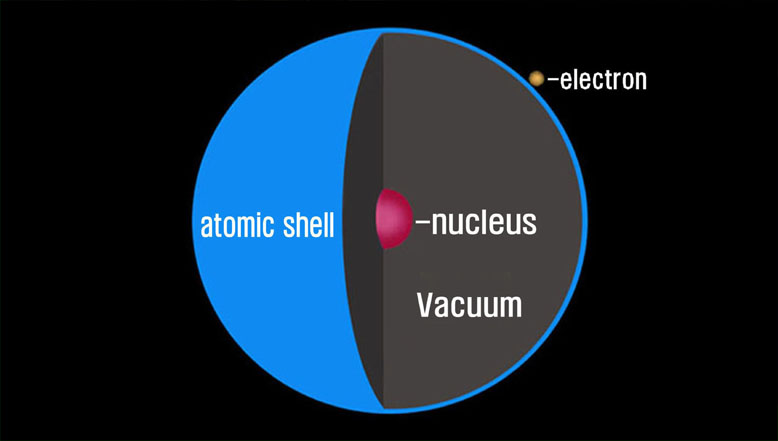
This is because only by breaking the shell of a hydrogen atom can it light a fire through nuclear fusion and become a shining star. Even though it is mostly made of hydrogen like Jupiter, it can never become a star without gravity to break the shell of hydrogen atoms that make up its core. Thus, a star is a celestial body that shines by itself by breaking the atomic shell and setting it on fire through nuclear fusion, and planet is a celestial body that cannot fusion because there is no gravity to break the shell of hydrogen atoms. Gravity is proportional to mass, and the greater the mass, the greater the gravity. Therefore,
if Jupiter also has the same mass as the Sun, it can break the shell of hydrogen atoms with gravitational force of that mass and become a self-luminous star through nuclear fusion.

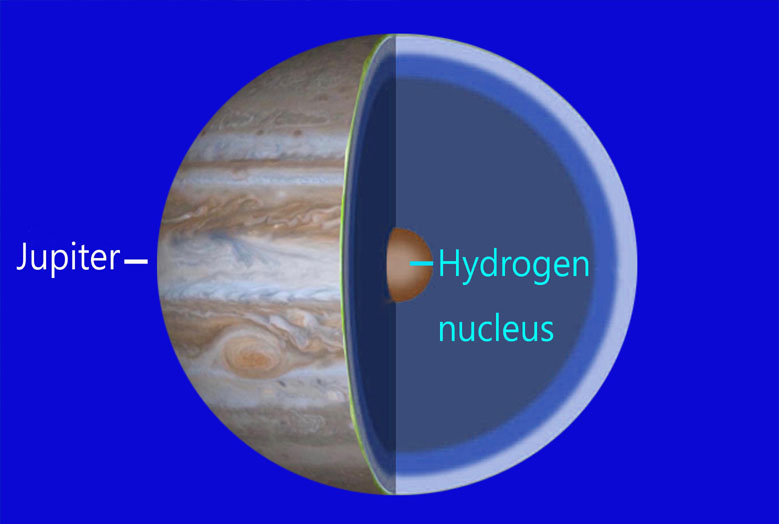
As shown in the figure above, hydrogen, which forms the nucleus of Jupiter, is compressed by gravity and becomes liquid states with metallic properties.

The above image symbolically shows how hydrogen atoms are compressed by gravity and become smaller as they enter into the center of the celestial body. In the case of the sun, there is a huge difference between the size of a hydrogen atom near the sun’s core and the size of a hydrogen atom at the outer part of the sun. Therefore, in the area occupied by one hydrogen atom in the outer part of the sun, billions of hydrogen atoms located at the extremely compressed center of the sun can fit. There is only one reason: the hydrogen atom in the center of the sun has become billions of times smaller than the hydrogen atom in the outer part of the sun due to gravity.
There is also a big difference in the size of hydrogen atoms near the core of the sun and the hydrogen atoms that make up the core of planets such as Jupiter. The reason is that the gravitational force proportional to the mass of the sun is much greater than that of Jupiter, so the hydrogen atom at the center of the sun is compressed that much more.
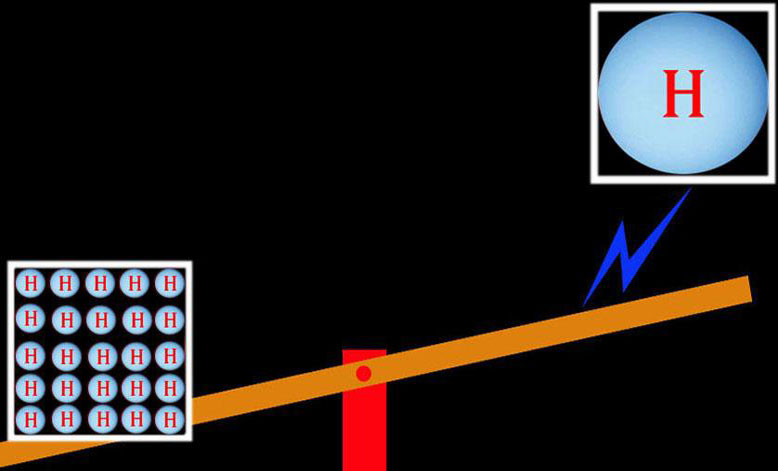
The figure above symbolically shows the presence of hydrogen atoms in the same area. As such, even with the same hydrogen atom, there is a difference in mass depending on the density. That is , when hydrogen atoms are extremely compressed in the center of a star, the shell of the hydrogen atoms collapses to produce deuterium and tritium.

As shown in the image above, when the atomic shell collapses due to compression by gravity, electrons orbiting outside the atomic shell enter the nucleus and combine with protons to be converted into neutrons. Then, the neutron combines with another proton to become deuterium, and one proton and two neutrons combine to form tritium.
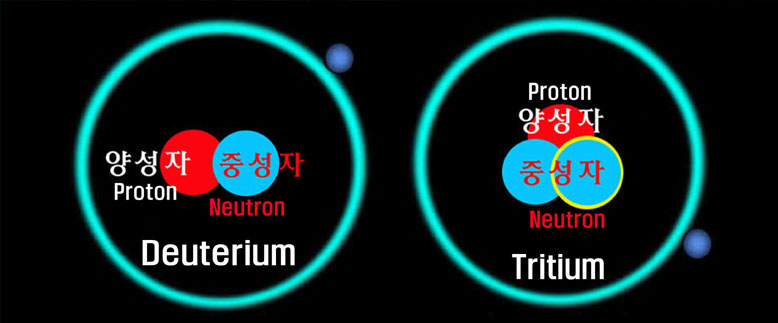
As shown in the figure above, in a deuterium nucleus, a proton and a neutron are combined, where as in a tritium nucleus, one proton and two neutrons are combined. At this time, the volume scale of deuterium and tritium generated in this way becomes smaller than the original hydrogen atom. That is, the mass and weight are twice as large as the original hydrogen atom, while the volume and the volume scale are smaller. It becomes smaller as it is compressed by gravity.
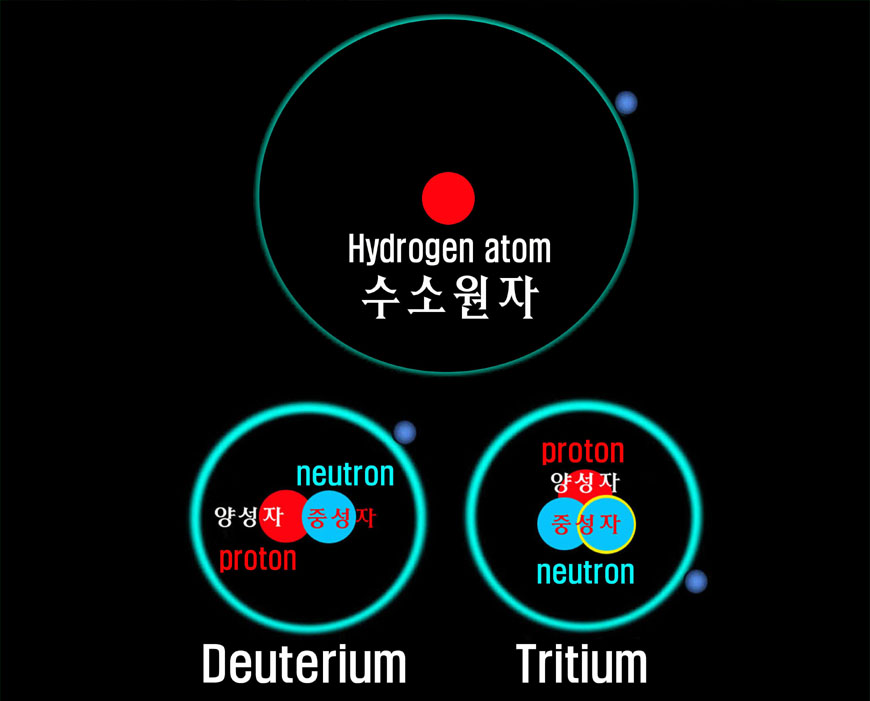
As shown in the image above, deuterium and tritium become smaller than the original hydrogen atom. While compressed by gravity to make it smaller, the atomic shell thickens. This is because it is thicker to protect the nucleus from gravity. Cosmic matter was created from the combination of deuterium and tritium. Starting with the combination of deuterium and tritium, all matter in the Universe was created.
One example is that deuterium and tritium combine to form helium through nuclear fusion.
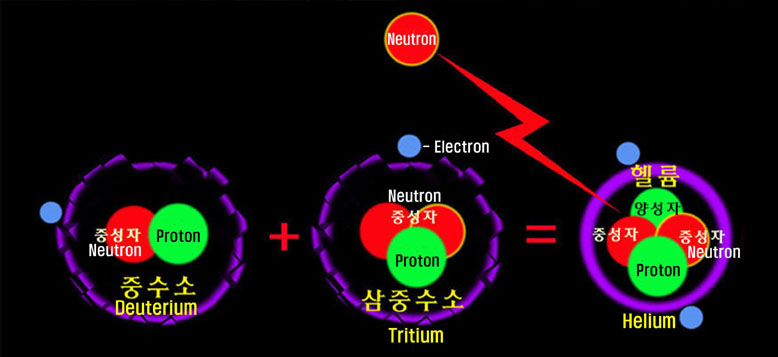
The figure above symbolically shows how the atomic shells of deuterium and tritium collapse and are converted into helium through nuclear fusion. At this time, the force of gravity that collapses the atomic shell must be enough energy to detonate a hydrogen bomb.
While ordinary bombs detonate with explosives in the center, hydrogen bombs contain deuterium and tritium raw materials in the center, wrap them with uranium, and then wrap the uranium with high-performance explosives, and are designed to explode sequentially from the outside.
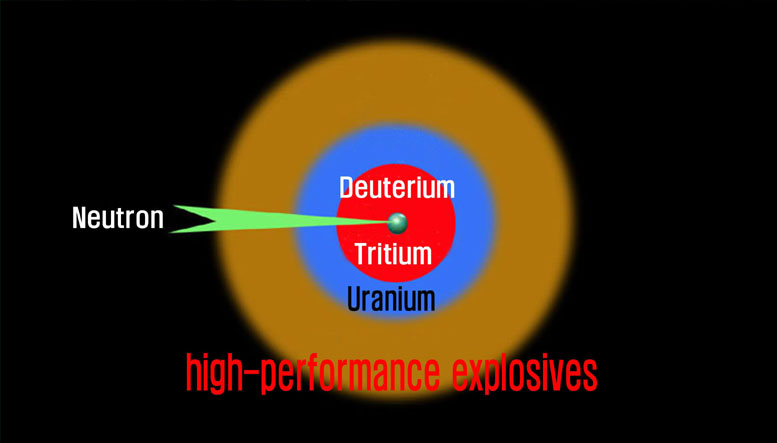
As shown in the figure above, the hydrogen raw material is covered with uranium, and the explosive is wrapped around it. There are two types of bombs, the inner-explosive method and the outer-explosive method. For general bombs, the outer-explosive method is to detonate from the center to the outside, and the inner-explosive method is to detonate from the outside toward the inside like a nuclear bomb.
In a hydrogen bomb, uranium acts as a trigger. By detonating a uranium nuclear bomb first, the generated energy is concentrated in the center, causing nuclear fusion of hydrogen. Hydrogen bombs are called thermo-nuclear weapons or nuclear fusion weapons because they do not cause a fusion reaction unless the atomic bomb triggers a high-temperature-high heat. Deuterium and tritium are used as raw materials for a hydrogen bomb, and these two are converted into helium by fusion by ultra-high temperature pressure. Nuclear fusion that occurs in stars is also performed by ultra-high-temperature-ultra-high-pressure created by the gravitational force that compresses the star’s core.
As such, star formation follows a very precise formula of the mass-gravity-density-temperature mechanism of a celestial body.

The figure above symbolically shows the atomic shell, which protects the nucleus of hydrogen and acts as an orbital for electrons. If it were not for this protective shell, which serves as the orbit of the atom, Jupiter could become a star like the Sun. Like the Sun, Jupiter is mostly made of hydrogen, but it has a smaller mass than the sun, and lacks the gravity, so it cannot break the shell of hydrogen atoms, so it cannot become a self-luminous star like the sun. However, without an atomic shell that protects the nucleus, Jupiter would have easily merged hydrogen and hydrogen into one to form helium through nuclear fusion, and would have become a star shining like the sun.
However, it is clear that the orbital movement of electrons is possible because there is an atomic shell that protects the nucleus, and because of the atomic shell, the physical existence of all things in the universe is satisfied. And the cosmic order is maintained by the function and role of the atomic world. Because of the atomic shell, the universe birth and evolution formula of mass-gravity-density-temperature mechanism is established.
2, Formula of the substance formation mechanism
At the center of the Sun, about 700 million tons of hydrogen bombs explode every second, and the power is more than hundreds of trillions of uranium atomic bombs. The hydrogen bomb tested by the Soviet Union in 1961 was 3,800 times more powerful than the atomic bomb detonated in Hiroshima, Japan. In the sun, nuclear fusion continuously occurs due to gravity and thermal expansion energy that is more than enough to collapse the shell of a hydrogen atom. And in the ultra-high temperature, ultra-high pressure, environment of the power of continuously detonating hydrogen bombs, helium atom shells are formed, producing helium with twice the mass of hydrogen atoms. And that helium becomes the nucleus of the Sun.
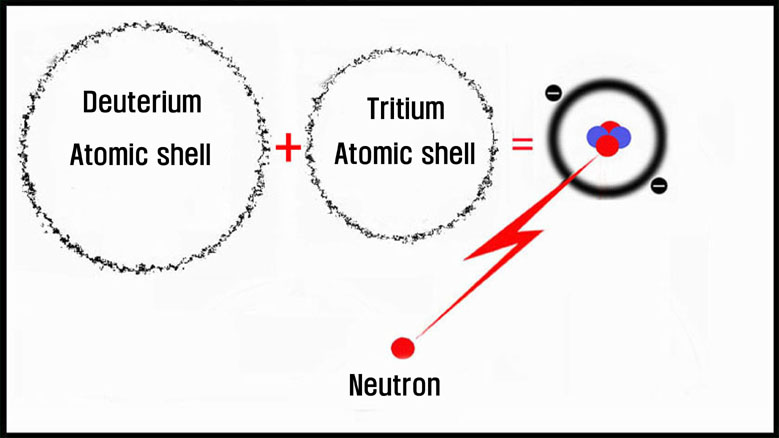
The image above symbolically shows how deuterium and tritium atomic shells collapsed and helium was created through nuclear fusion. The volume of this helium atom is compressed by gravity, making it smaller than the hydrogen atom, while the atomic shell becomes thicker.

As shown in the figure above, helium has a smaller volume than a hydrogen atom, but the shell of the helium atom is thicker to protect the nucleus from gravity. What is important here is the power that made the helium atom shell. Gravity and thermal expansion energy that caused nuclear fusion by collapsing the shell of hydrogen atoms are the driving forces to create the shell of helium.
Without that power, helium could not have been created, and without helium the universe would not have been possible.
And another power that created the helium atomic shell comes from the rotational motion of the atomic nucleus. A gravitational field is formed by the energy such as magnetic force and electromagnetic waves emitted by the rotation of the atomic nucleus, and the helium atom shell is created by these energies. Two hydrogen atom nuclei combine into one, and the doubled energy makes the helium atom shell thicker and stronger than the hydrogen atom shell.
So then, how are atoms with a mass heavier than helium formed? To make a material with a mass that is heavier than a helium atom, energy is needed to collapse the helium atom’s shell. Nuclear fusion in the midst of high-density and high-temperature created by gravity means that two atoms combine to form one atom, and as an atom increases in mass, while it’s volume decreases. And, as two atoms combine to form one atom, the space occupied by one atom remains. A hydrogen atom has the largest void space compared to other atoms. In general, if the size of an atomic nucleus is about a pea, the empty space inside the atom surrounded by the atomic shell is the size of soccer field. When two atoms merge into one in the process of nuclear fusion, the empty space left behind is this large.
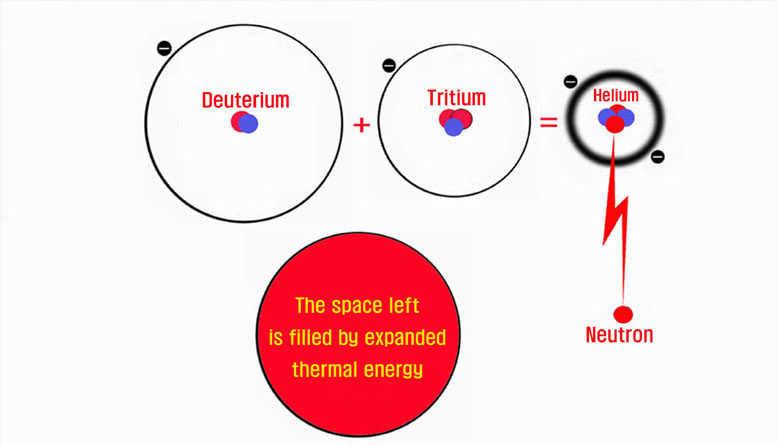
As shown in the figure above, as two atoms combine to form one through nuclear fusion, an empty space occupied by one missing atom is created, and the expanded thermal energy fills the empty space.
If so, what is the physical phenomenon of thermal expansion energy and its cause?
As water boils, it changes to a vapor state and flies away because the space of atoms constituting water molecules expands. Then, why did the atomic space constituting water molecule expand, and what is the cause of the expansion? Until now, in thermodynamics, we only know that heat (energy) is applied to water in liquid state, it changes to gas phase. And when it becomes a gas, its volume expands, but it becomes lighter and evaporates away. However, the main culprit for expanding the atomic space is Vacuum Particles, that is, Original Particles. These vacuum particles exist in general vacuum as well as cosmic vacuum and black hole vacuum, and they always flock to a place where there is energy and cause the thermal expansion. And the use of this thermal expansion physics is a power generation system facility using a steam turbine, and a jet propulsion system that realizes today’s aircraft.
With modern science, the mass of the vacuum particles that make up the vacuum, that is, the original particles, cannot be measured. However, it has known for a long time that the density mass of vacuum particles compressed in a black hole is about 18 billion tons per cubic centimeter. And that the density of a black hole is about 18 billion tons per cubic centimeter means that there is a reality of its weight. So, what is the reality of a density-weight mass of about 18 billion tons per cubic centimeter in a black hole vacuum? The substance is, in the process of the decay of atoms constituting matter, the nucleus of an atom decays into electrons, electrons into neutrinos, neutrinos into photons, and finally, photons collapse in a black hole environment and are returned to their original state. And it is the vacuum particle, that is original particle. In other words, everything in the universe we see now appears as a result of the combination of these vacuum particles, that is original particle.

The picture above shows heating a jar placed upside down. When the jar is heated in this way, the air molecules are heated and expanded and escaped out of the jar. If you light a candle in a dark room, you can see the original particles flock and combine and transform into photons. In this way, the original particles are not only converted into photons, but also evolve into fire-particles, acting as a combustion catalyst. And when energy is lost, it returns to the original particle state. The original particle is the main culprit of thermal expansion and serves as a catalyst for phase change of all energy.
In stars like the sun, as successive nuclear fusion continues, the empty space occupied by the other missing atom continues to expand as the two atoms combine into one. At the center of the Sun, about 700 million tons of hydrogen per second undergo nuclear fusion, and the energy generated when 1 gram of hydrogen evolves into helium in this process is equivalent to the energy emitted by 600 million electric heaters for I second. In addition, since the space occupied by the atom decreases as the mass of the atom increases, the empty space become larger. At this time, the empty space is filled with original particles converted into thermal energy. And, the thermal expansion energy created in this way adds to gravity and accelerates nuclear fusion. Artificial nuclear fusion proceeds by maximizing high-temperature expansion energy, but natural nuclear fusion that occurs in space proceeds by gravity and thermal expansion energy. As successive nuclear fusion continues, the thermal expansion energy becomes larger and larger. Then, when the outer layer reaches a limit where it cannot handle the expansion energy that continues to expand from the inside, it is pushed by the energy and expands further. As it is compressed, the expanding energy pushes and expands the outer layer even more strongly. Our sun will reach that limit in about 5 billion years. At that time, the volume of the Sun will expand rapidly. Then, the Sun will engulf the nearest planets, Mercury and Venus, and rush towards Earth.
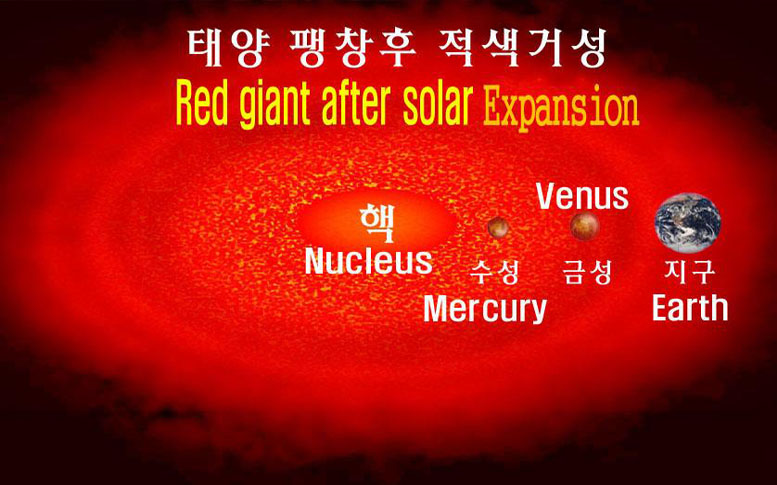
The figure above symbolically shows how the sun, which evolved into a red giant, swallowed up planets reaching the Earth. Of course, this is a far cry from now and will happen in the distant future.
Space evolution formula part B
In this way, when the radius of a star expands about 1,000 times during the expansion process, the surface temperature decreases, while the temperature at the center rises rapidly and reaches about 100 million K. This is a phenomenon that occurs as the density increases by the expansion energy. As a result, the helium atomic shell in the star’s core collapses, causing successive nuclear fusion.
Supernovae use explosive energy to cause nuclear fusion by collapsing the most stable and strong iron atomic shell, whereas red giants use expansion energy to cause nuclear fusion. The phase of a red giant takes about 100 million years. During that time, materials such as lithium, beryllium, boron, and carbon, which are heavier than hydrogen and helium, were formed, and carbon occupied the star’s core. And stars that are more massive than the Sun can produce nitrogen and even oxygen. The heavier the mass, the greater the gravitational force, so it is possible to create materials with heavier mass.
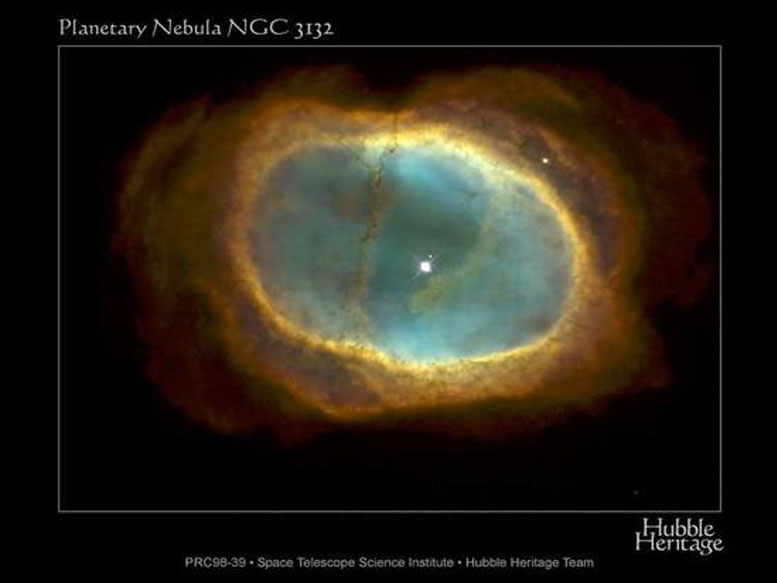
Hubble Heritage The outer layer of a red giant is mostly hydrogen, and its outer layer continues to expand, forming planetary nebulae that decreases in density. As seen in the satellite image above, a red dwarf star evolves into a planetary nebula, and in the process, the outer layer, which was once a body, is scattered into outer space, leaving only the nucleus. And the remaining core gradually loses its light and cools down, and this object is called a white dwarf. The white dwarf is visible in the center of the above observation photo.
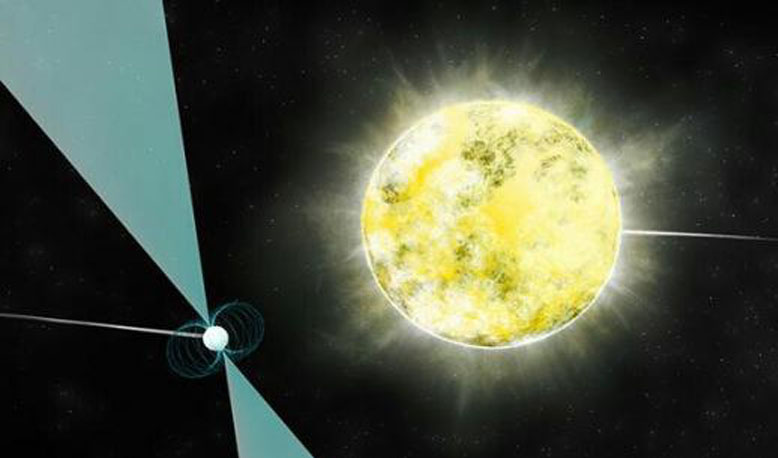
This white dwarf, discovered by a joint research team from the University of Wisconsin and other U.S.- National Radio Observatory using observation equipment such as the ultra-long baseline radio telescope, is said to be the coldest and faintest object ever discovered. This white dwarf is located in the constellation Aquarius, about 900 light-years from Earth, and is the size of the Earth. It is estimated that it will not exceed 2700 degrees Celsius. In particular, the research team believes that this white dwarf is made of diamonds. This diamond, made of carbon, is created in the cosmic evolution formula of the mass-gravity-density-temperature mechanism. This white dwarf, made up of mostly carbon, slowly cooled over billions of years and evolved into diamond crystals, the team estimates. The research team named this white dwarf “the diamond of the Universe.”
Professor David Caplan, who led the study, explained, “This white dwarf, estimated to be about 11 billion years old, has been there for a long time, but it is too faint to be discovered.” “Theoretically, the cold white dwarf like this is not rare,” said the Professor. “It is about ten times fainter than a normal white dwarf.” said.
Nuclear fusion no longer occurs in white dwarfs. Therefore, it gradually cools down because it cannot generate energy. A typical white dwarf has about half the mass of the Sun, a diameter slightly larger than that of the Earth, but with the density that can hold the diamond-like crystal core.
White dwarfs cool over tens of billions of years, and compared to the age of the Universe, which is only 13.8 billion years, even the oldest white dwarfs maintain a temperature of several thousand Kelvin. Therefore, most white dwarfs are very hot, and it takes about 25 billion years for a white dwarf, which is about half the mass of the Sun, to reach the same ambient temperature.
These stars are in globular clusters, group of older stars. As the interior of the white dwarf cools slowly over time, it is speculated that it will eventually settle into diamond-like crystals. After a long period of time, when the white dwarf is completely cooled to the same ambient temperature, the white dwarf will turn into a black dwarf. In theory, it would take tens of billions of years for a white dwarf to become a black dwarf. It is estimated that there are no black dwarf stars in the Universe, which is only 13.8 billion years old.
A white dwarf cannot exceed 1.4 times the mass of the Sun. However, a white dwarf constituting a binary system can be resurrected by stealing material from its companion, increasing its mass-gravity.
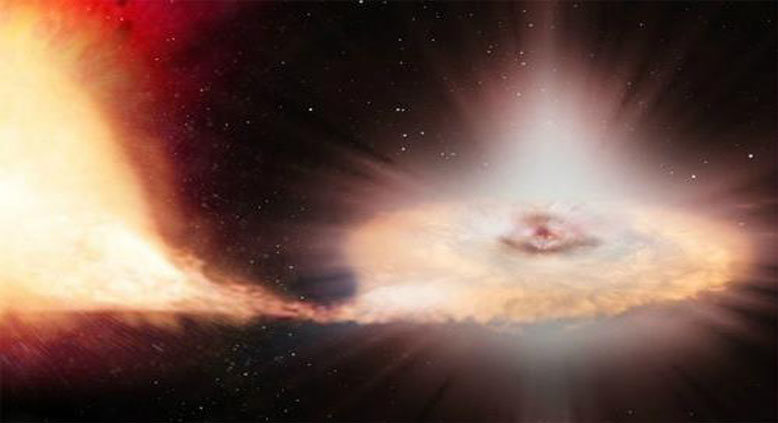
ESA-provided image above shows a white dwarf taking material from its companion, causing a supernova explosion. As the companion star’s material moves to the white dwarf, the gravitational force corresponding to its mass also moves. And this increased gravitational force collapses the atomic shells of carbon or oxygen that make up the nucleus of the white dwarf, allowing nuclear fusion to produce many materials, including iron.
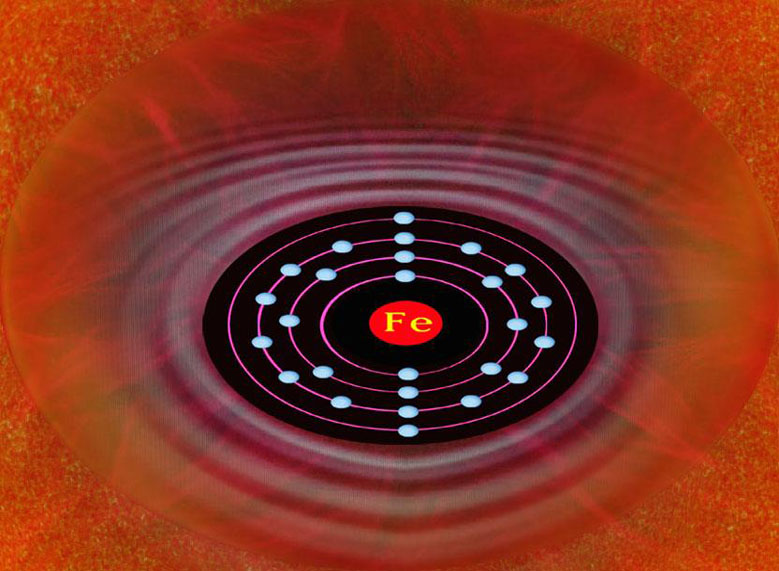
The above image symbolically shows the iron-atom that make up the core of a star that is 20 times the mass of the Sun. The materials that can be created with the formulas of a general star’s mass-gravity-density-temperature-thermal expansion energy are limited to iron-atoms. The iron-atom has a stable and strong structure that is most resistant to gravity. Therefore, in order to make a material with a mass heavier than an iron-atom, the iron-atomic shell must collapse with a force greater than the energy of nuclear fusion or thermal expansion, which is formed by a supernova explosion.
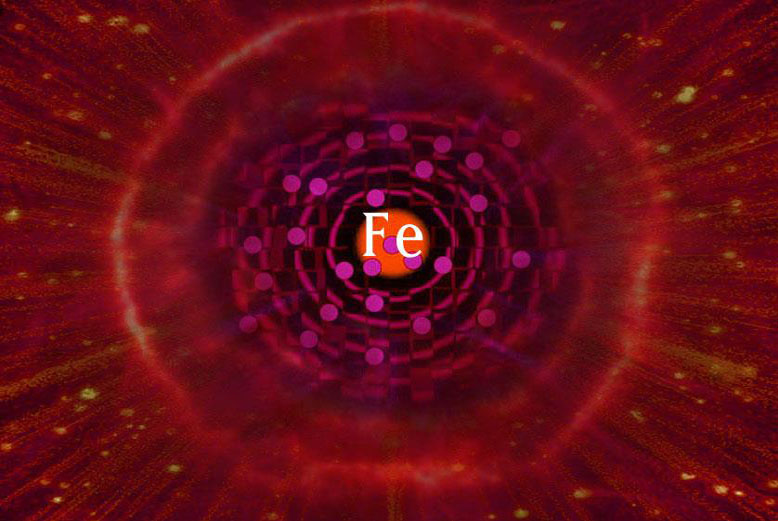
The image above symbolically shows the collapse of one of the iron atoms that made up the star’s core in the energy of the star’s explosion. Just as a solar-mass star uses its expansion energy that leads to a red giant, to collapse the helium atomic shell and create matter with a mass heavier than helium, the supernova explosion force collapses the iron-atom, which has the most stable and strong structure. Thus, substances with a mass heavier than an atom are produced. In order to make matter with a mass heavier than iron, the supernova explosion force must be added to the cosmic evolution formula based on the mass-gravity-density-temperature mechanism.
3) Formula of the mechanism that determines the lifespan and type of stars
Living things are made up of cells, cells are made up of molecules, and the molecules that make up all matter in the world are made up of atoms. And all atoms constituting all these substances are fused or bonded, starting from a hydrogen atom. Therefore, the type of material is classified according to how many hydrogens are in the atom. For example, if there are 2 hydrogen atoms, it becomes helium, if there are 7 hydrogen atoms, it becomes nitrogen, if there are 8 hydrogen atoms, it becomes oxygen, and if there are 26 hydrogen atoms, it becomes iron.
These materials are made through nuclear fusion in stars, and while only helium is produced in a star with a low mass, many materials can be produced in stars with greater mass by the mass-gravity-density-temperature mechanism formula. Even today, a lot of helium is being produced through explosive nuclear fusion in the core of the Sun. In this fusion process, the volume of helium becomes smaller due to the pressure of gravity, while the atomic shell becomes thicker to protect the nucleus from the pressure by gravity.
The rate of nuclear fusion is determined by the mass-gravity-density-temperature mechanism. As the mass of a star increases, the pressure and temperature of the gravitational force that presses on the central core rises, leading to faster nuclear fusion. And the smaller the mass of the star, the lower the temperature and the force that compresses the core, the slower the fusion rate. In addition, the lifespan of stars is determined by the rate of nuclear fusion. The faster the fusion rate, the shorter the lifespan, and the slower the fusion rate, the longer the lifespan.
Therefore, the lifespan of a supernova with high energy due to the mass-gravity-density-temperature mechanism is only several million years, whereas a Sun with tens or hundreds of times less than a supernova can live up to 10 billion years. And red dwarfs with less than solar mass can live up to 17.5 trillion years.
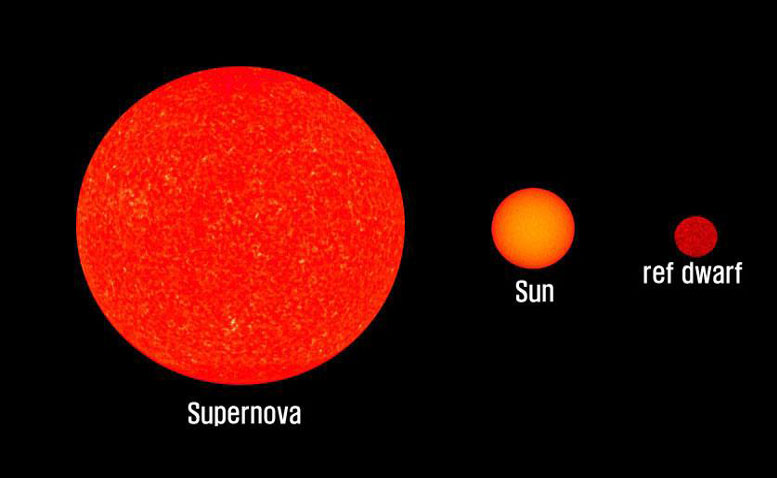
As shown in the image above, the larger the mass, the shorter the lifespan. The lifespan and types of stars are determined by the cosmic evolution formula based on the mass-gravity-density-temperature mechanism.

As shown in figure above, the mass of a red dwarf is less than 46% of that of the Sun, a mass of brown dwarf is less than 8% of that of the Sun, and a mass of a brown dwarf is more than 13 times of that of the Jupiter.
Therefore, Jupiter can become a star if its mass is more than 13 times larger. Although it cannot shine as brightly as the Sun, it can become a celestial body like a brown dwarf. As the mass increases, the gravity increases in proportion, and the increased gravity increases density of the core and generates a high temperature, causing nuclear fusion. As such, the sophisticated formula for cosmic evolution is not an abstract theory or asserted claims, but can be confirmed by physical evidences that have been observed and verified by the advanced observation technology of modern space science.
4) Formula of the mechanism by
which a star evolves
The evolution of stars also takes place through the mechanisms of mass-gravity-density-temperature. In stars more than 10 times the mass of the Sun, the strong and most stable iron atomic shell collapses by the gravitational-density-ultra-high-temperature explosion energy mechanism. Then, electrons orbiting outside the shell of iron atoms enter the nucleus and combine with protons to be converted into neutrons
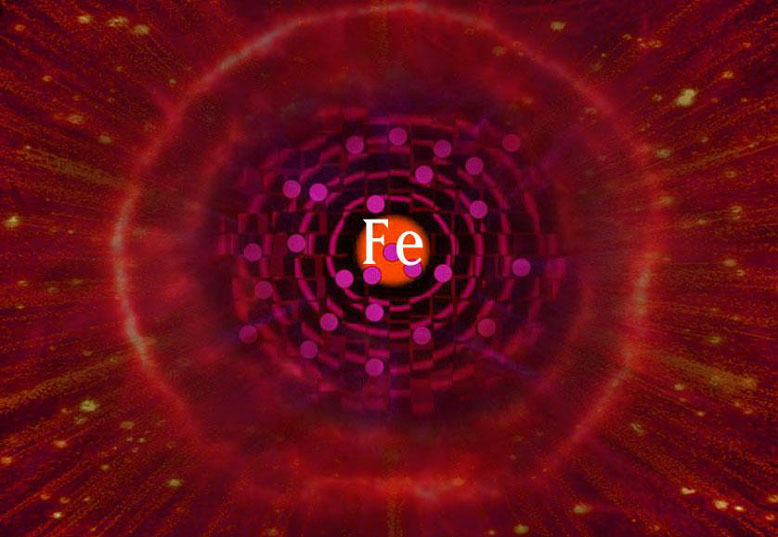
The image above symbolically shows how the orbit collapses and electrons rush into the nucleus as the iron atom’s shell collapses among the mechanisms of mass-gravity-density-temperature of a star that is 10 times more massive than the Sun’s mass. The electrons pushed into the nucleus combine with the protons that make up the nucleus and are converted into neutrons. Stars born in this way are called neutron stars, and neutrons also decay in an environment that exceeds the limit pressure and temperature due to the mass-gravity-density-temperature mechanism.
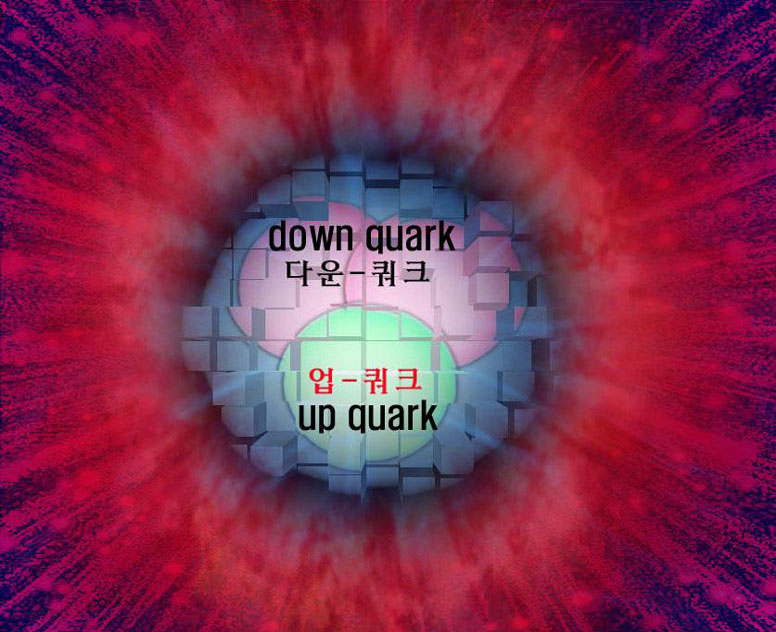
The above image symbolically shows the decay of quark particles that make up neutrons. In the formula for the mass-gravity-density-temperature mechanism of stars greater than neutron star’s compression density, even neutrons decay and evolve into the most compressed-density black hole in the Universe.
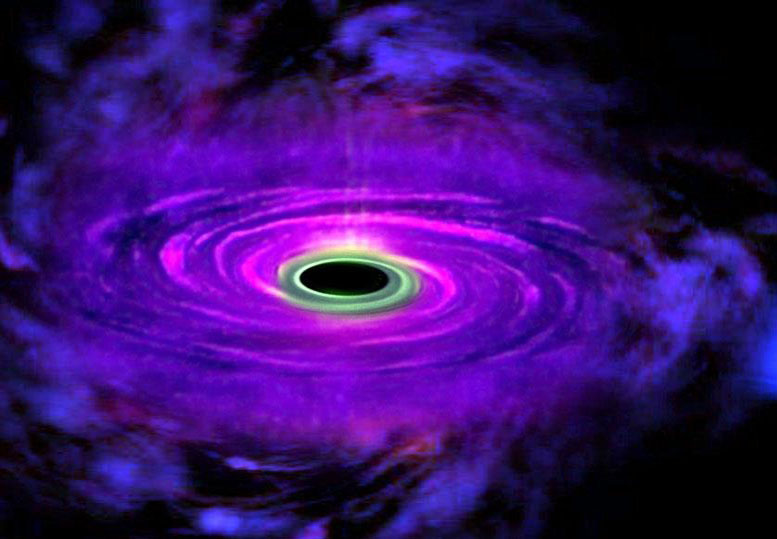
The figure above symbolically shows the appearance of a black hole. The compressed density of a neutron star composed of only neutrons in the process of atom decay is 1 billion tons per cubic centimeter, and the compressed density of a black hole, where even neutrons decay and only vacuum particles (original-particles) remain, is about 18 billion tons per cubic centimeter. The evolution of celestial bodies in the Universe takes place in the formula of the Mass-gravity-density-temperature mechanism.
5) About the Fiction of the Big Bang Theory
The Universe has evolved in the mechanism of mass-gravity-density-temperature, as mentioned so far. However, in the Big Bang theory, there is no such official mechanism for cosmic evolution. According to the Big Bang theory, the temperature reached 10 billion degrees C one second after the Big Bang singularity exploded, and cooled to 1 billion degrees C after 3 minutes.

The image above symbolically represents the temperature after the Big Bang-Singularity explodes. However, from what is known, the temperature of the matter emitted from the black hole is about ten thousand times higher than the temperature at the time of the Big Bang-singularity explosion. Researchers of the United States and Russia have confirmed that the temperature of the material emitted from the black hole, the nucleus of a new galaxy, is about 99,999 trillion degrees Celsius, according to the state-of-the-art high-tech satellites. As such, the fact that the temperature at the time of the Big Bang is lower than the temperature of matter emitted from the black hole is a physical result that the mass-gravity of the big bang-singularity is smaller than that of the black hole. There is no place in the Universe where the mass of matter can be compressed any lower than a black hole. However, what does it mean that the temperature at the time of the Big Bang was lower than the temperature of matter emitted from the black hole and less than the mass of the black hole? This means that even a shovel of soil cannot be made with the mass of a Big Bang-singularity smaller than the hole of a needle. However, big bang theorists claim that the weight of the big bang singularity is equal to the total mass of the Universe containing over 100 billion galaxies. And this is more absurd than fiction itself.
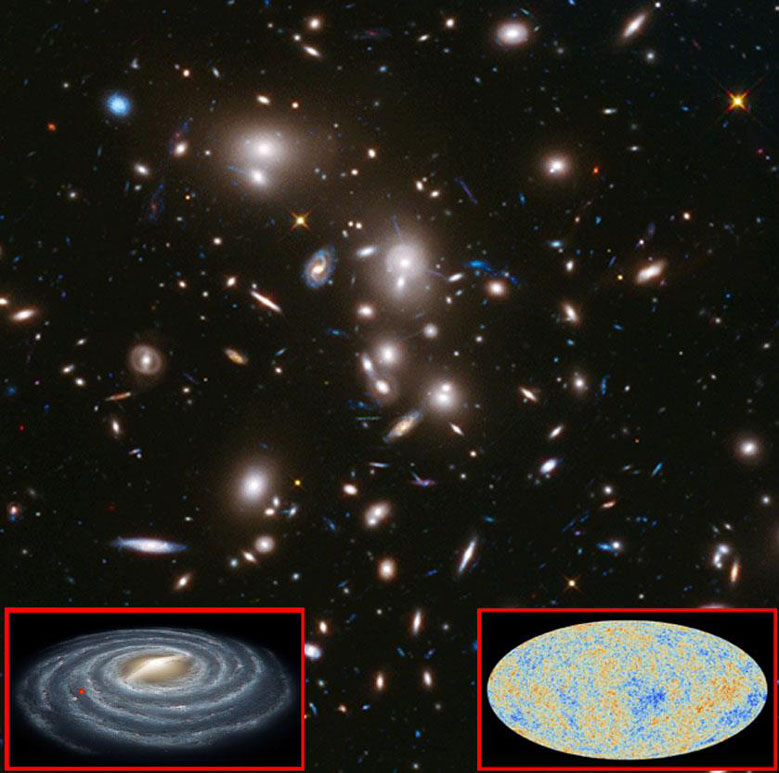
The photo above (provided by NASA) symbolically shows the Milky Way Galaxy at the bottom left and the Early Universe (right) 380,000 years later, with a piece of the furthest universe in the back ground. In the Universe, there are more than 100 billion galaxies, and galaxies contain hundreds of billion stars, tens of billions of planets, and countless black holes. There are about 100 million black holes, 300 billion stars, and 50 billion planets in our galaxy. If the Big Bang theory is correct, if the Early Universe expands to the size of our Milky Way, its mass-weight should be more than 1 trillion times that of the present Milky Way. The mass of dark matter is not calculated here. Naturally, If the mass becomes that large (trillion times), of course, the density and temperature due to the gravity must also increase by that much. However, the fact that the temperature at the time of the Big Bang was about 10 billion degrees, which was only 1/10,000 of the temperature of matter emitted from a black hole, cannot be explained other than that the Big Bang theory is a FICTION.
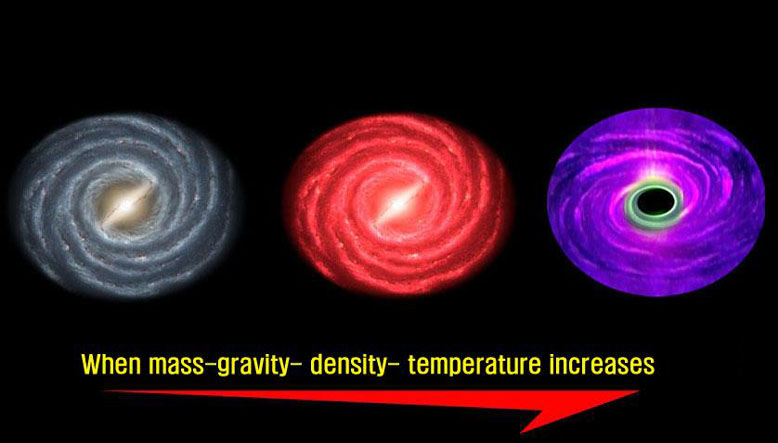
The image above shows the phenomenon when mass-gravity-density-temperature increases. When the mass of celestial bodies in our Galaxy increases by more than 100 times, the density increases due to the gravitational force of the mass, and the high temperature occurs, and even planets such as Jupiter orbiting the solar system become stars. Then the Sun evolves into a black hole and begins to devour its moons. In order for a celestial body to evolve into a black hole in the universe, it means that all atoms are decayed, even neutrons are disintegrated and converted and compressed into vacuum particles in the final stage. The physical truth is that if the sun increases by only 100 times, high temperature and high pressure will form enough to evolve into a black hole. On the other hand, it was confirmed that the temperature of the temperature rising area of the Early Universe revealed by the observations of the European Space Agency was about 2,700 degrees C. This fact is physical evidence proving that the mass of the Early Universe was thousands of billions of billion times smaller than the present Universe. If so, what can prove the absurd claim that the weight of the Big Bang Singularity is the same as the current Universe? According to the Big Bang theory, hydrogen should no longer be generated in the Universe. Because it was all made at once at the time of the big bang. However, even now, hydrogen is being produced explosively in space. Evidence is that neutral hydrogen continues to form and diffuse around the star-forming galaxies. In space, hydrogen is produced only in a vacuum without interference from other energies, so it is not produced in galaxies with closed orbits such as elliptical galaxies. Hydrogen is generated outside the orbit of galaxies with open orbits, such as spiral galaxies, and is being produced explosively in irregular galaxies that have not yet formed orbits. For this reason, few stars are formed in most elliptical galaxies, stars are formed in spiral galaxies, and explosive formation in irregular galaxies. While neutral hydrogen, which is electrically neutral, is rare in most elliptical galaxies, it can be observed that it diffuses around spiral galaxies and irregular galaxies. It is a blatant lie that everything the universe needed was created in the first three minutes of the Big Bang.
What is clear is that even now, hydrogen is being generated explosively in space, and the Universe is not shrinking, but continues to expand at a very high rate.
The formula of mass-gravity-density- temperature mechanism