ABOUT
회사소개
고객지원
T. 02-858-5357
F. 02-859-5357
dhk5@hanmail.net
 HOME > 회사소개 > 수소논문
수소논문
Title of the Thesis:
Hydrogen is still being
generated explosively in Space
The 1st Writer : DR. DAE HO KIM
Hydrogen is still being generated explosively in Space
Modern space science and technology is at the point of observing 100% of the universe. Therefore, it means that the secret of the universe has also reached the point where it can be revealed without limitation. However, astrophysicists brainwashed in the Big Bang theory stubbornly argue that only 4% of the universe can be seen. This is because the field of view was limited to 4% by the Big Bang, as if the frogs in the well could see only a limited space of view. Hydrogen is still being generated explosively in space, but astrophysicists brainwashed in the Big Bang Theory are not trying to admit it while observing it. This is because, according to the Big Bang Theory, it is believed that all hydrogen was produced in the 30 minutes immediately after the creation of the Universe, and thus hydrogen could not be produced in space any more. However, the fact that hydrogen is still explosively generated in space is not a new theory, but a fact that is actually going on in space, and it is a clear fact that can be confirmed by physical evidence that can be observed and presented through radio telescopes. Stars are formed when cloud nebulae, mostly consisted of hydrogen, be compressed by tens billions of times high compression. And, there are still galaxies in the universe that simultaneously generate thousands of stars, and core of an active galaxy is emitting a huge amount of material that can create thousands of stars, but none of them shrink or shrink due to the depletion of hydrogen. There are no galaxies getting smaller.
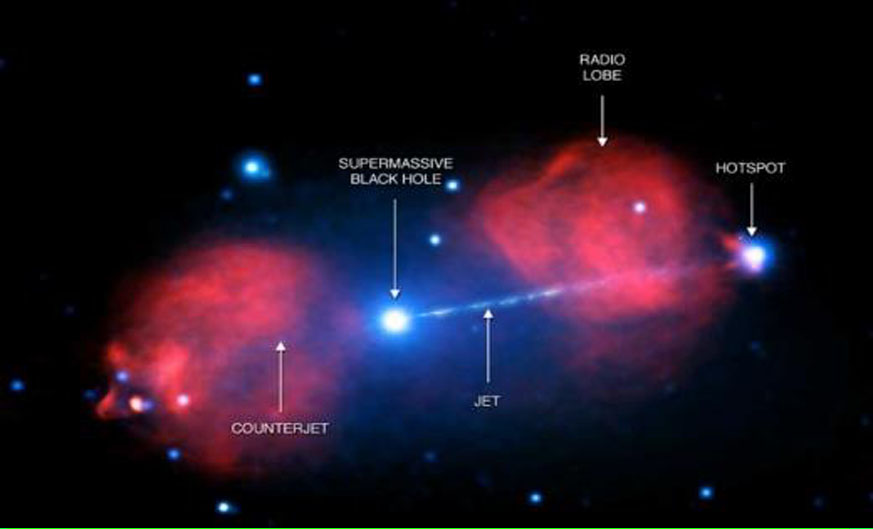
Observational evidence in the photographs shows that the central core nucleus of the galaxy (Pictor A) releases vast amounts of cosmic matter to both-side. After 15 years of observation with NASA’s Chandra X-ray telescope, the material emitted from the galaxy has extended up to 300,000 light years. Considering that the diameter of our Milky Way Galaxy to which the Earth and the Solar system belong is 100,000 light years, it is truly an enormous scale. According to the Big Bang Theory, if hydrogen was created in the entire universe within 30 minutes after the Big Bang, the Universe should have been shrunk by now, and even if hydrogen is being produced in the universe, that should have been impossible. But the undeniable thing is that the hydrogen is being generated explosively in the Universe, and the Universe is rather constantly expanding. The fact that hydrogen is being generated explosively in space and that the Universe is constantly expanding are undeniable facts presented through radio telescopes.
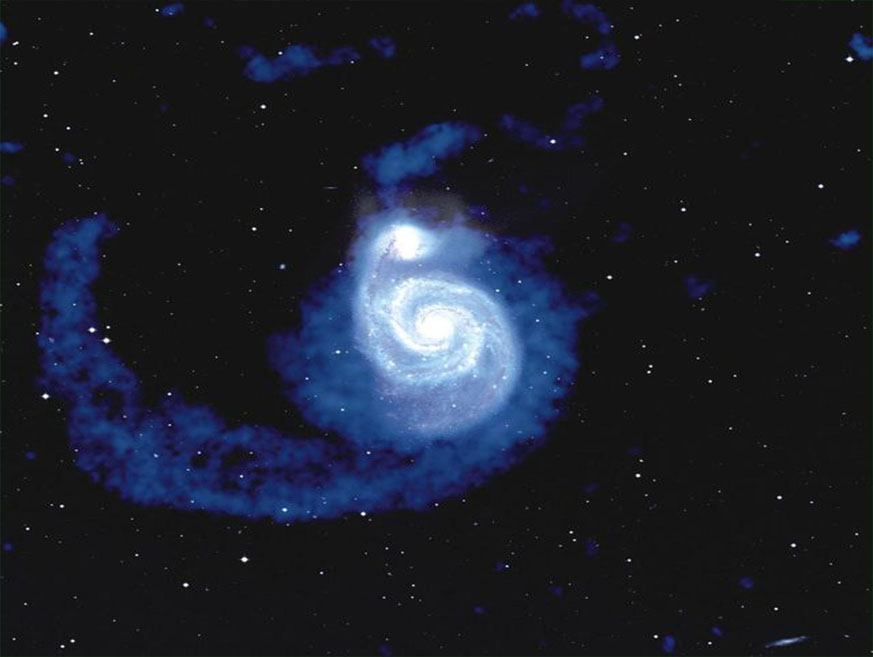
The satellite observation picture above shows that the blue hydrogen cloud surrounding the white galaxy extends long to the left, which was formed by the formation of blue neutral hydrogen around the galaxy. Electrically neutral hydrogen is called neutral hydrogen because it is electrically neutral when hydrogen is first generated in space. And since this neutral hydrogen is not visible in visible light, it can be observed through a radio telescope. All objects in the universe emit electromagnetic waves of various wavelengths, and the electromagnetic waves that we can see with our eyes are called visible rays. Ultraviolet rays, X-rays, gamma rays, etc., which have a shorter wavelength than visible rays, cannot be seen with the eye.
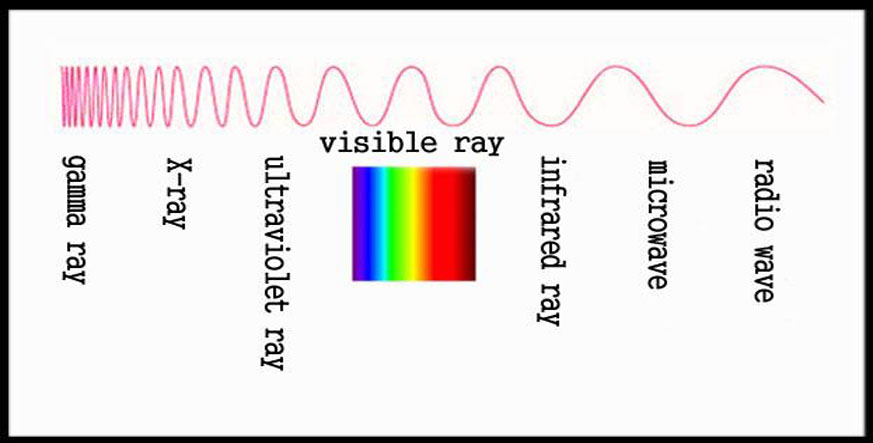
As shown in the diagram above, electromagnetic waves with shorter or longer wavelengths than visible rays cannot be seen with the eye. And this means that visible things are not all the truths.
When an event such as an explosion of a supernova or a collision of celestial bodies occurs in space, electromagnetic waves of various wavelengths such as X-rays as well as visible rays are emitted. And all those waves from space contain information on various events occurring throughout the universe. Radio waves are also a means of communicating humanity’s information, but it is also a means of communicating information about all kinds of events occurring in space. Among them, radio telescopes are the best means of communication. Without radio telescopes, modern astrophysics would still be wandering in the dark.
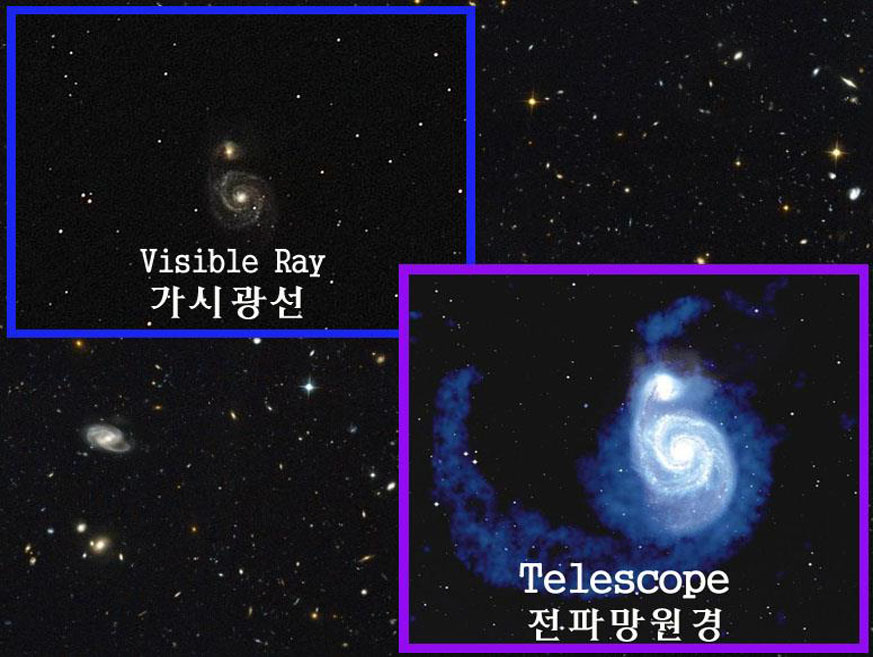
As shown in the figure above, the neutral hydrogen region, which was not visible in the visible light band, was confirmed by a radio telescope. And in this galaxy, many newly born stars were identified. The reason why many young stars are born in galaxies is that they have a lot of material to create them, which is proportional to the amount of neutral hydrogen gas. In general, in spiral and irregular galaxies, neutral hydrogen accounts for more than tens of percent of the mass, whereas elliptical galaxies that cannot produce stars are almost depleted of neutral hydrogen gas. There are spiral galaxies, elliptical galaxies, and irregular galaxies in the Universe. Hydrogen cannot be produced in galaxies with closed orbits like elliptical galaxies. Therefore, there are no young stars in the elliptical galaxy, only old stars.
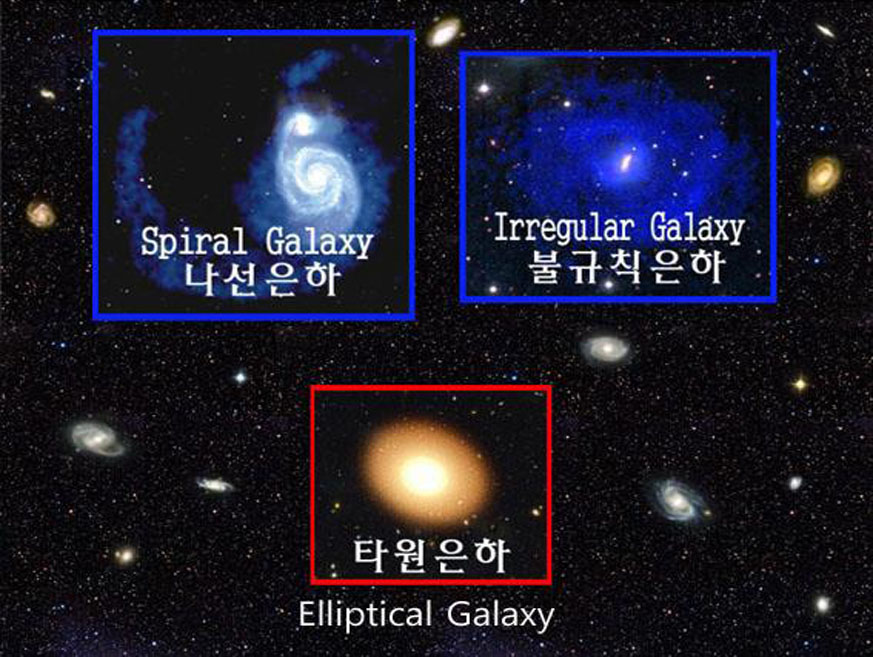
The figure above shows a symbolic comparison of spiral and irregular galaxies that generate hydrogen, and elliptical galaxy that cannot generate hydrogen. Hydrogen is generated explosively in irregular galaxies, but when orbits are formed in these galaxies, hydrogen production decreases. Because of this, many stars are formed in irregular galaxies, whereas star formation gradually decreases in spiral galaxies.
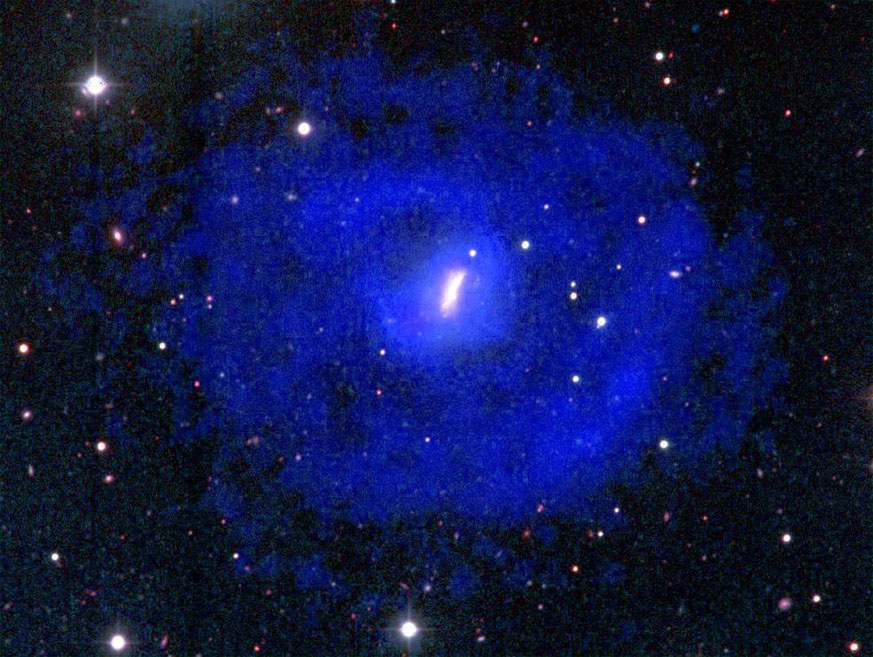
The photo above (provided by EST) is new born irregular galaxy surrounded by a cloud of neutral hydrogen. The white celestial body in the picture is the image observed in visible light, and the blue neutral hydrogen region is the image observed with a radio telescope. This new born irregular galaxy, visible invisible light, appears to be a small galaxy, and when observed with a radio telescope, a large area of hydrogen clouds can be identified. The diameter of the white celestial body seen in the visible light at the center of the photo is about 6,000 light years, while the diameter of the neutral hydrogen region observed with a radio telescope is about 40,000 light years.
The spreading hydrogen clouds surrounding this galaxy, about 16million light years away from Earth, are uninterrupted by other energies, reproducing the appearance of the Early Universe.
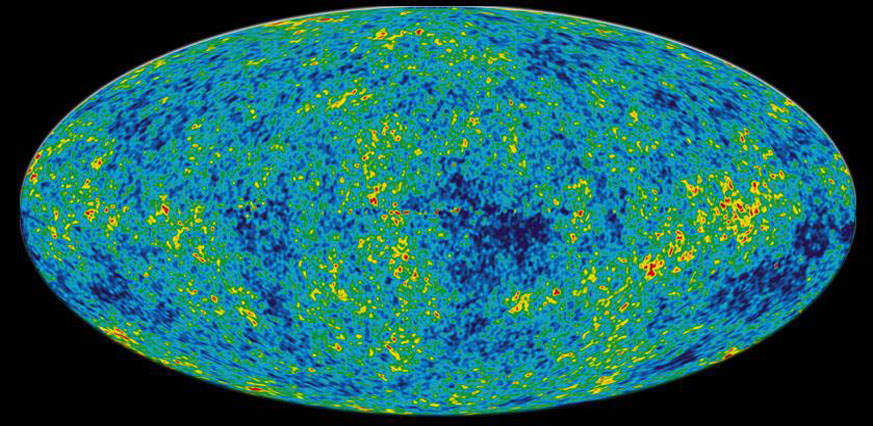
The early universe (picture provided by NASA) which did not yet have stars and planets, consisted mostly of neutral hydrogen atom. And these neutral hydrogen atoms were ionized at the center where the density increased and were combined into molecules. Even in the present universe, dark galaxies that have not yet formed stars are composed of neutral hydrogen, which is also ionized in the center where high temperature occurs due to its density and is combined into molecules. And this ionized region composed of hydrogen molecules is called an ionized hydrogen region. In the ionized hydrogen region, numerous stars are conceived and born over millions of years. And the energy emitted by these stars ionizes neutral hydrogen and expands the ionized hydrogen domain. However, in elliptical galaxies that do not form stars, there are no regions of neutral hydrogen and ionized hydrogen. With one exception, elliptical galaxies can acquire neutral hydrogen and ionized hydrogen regions when they collide with other galaxies, as are other galaxies. In the case of galaxies, hydrogen production and star formation decrease as orbits are formed, but when the galaxy’s orbit is destroyed by the attraction force of another galaxy with a larger mass, hydrogen production and star formation may become active again.
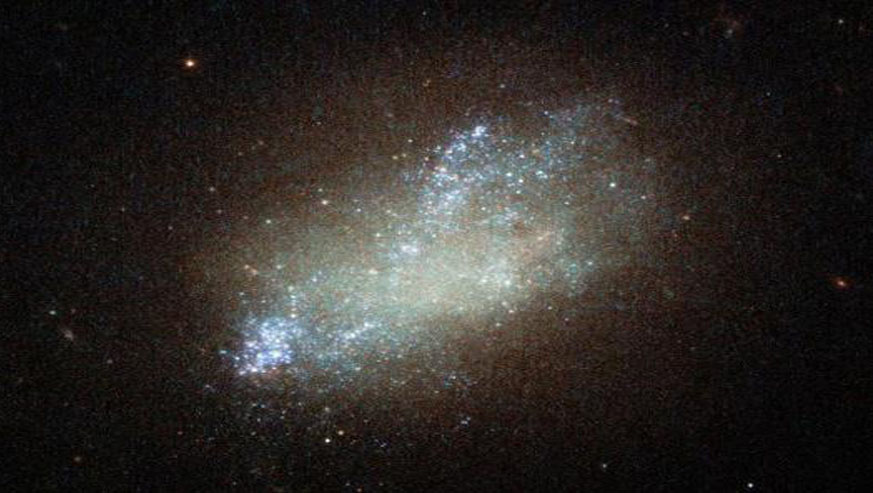
The above image, provided by NASA, is an irregular shape of the Large Magellanic Cloud with a central bar but no spiral arms. Globular clusters of stars with extreme age differences exist in the Large Magellanic Cloud. And unlike our Milky Way Galaxy, this galaxy (the Large Magellanic Cloud) has many mysteries, such as producing many stars and being very active. According to the theory of modern astronomy, the Large Magellanic Cloud should consist of tens of millions of stars just like other satellite galaxies, and it is natural to be in the form of a dwarf spherical galaxy. In reality, however, the Large Magellanic Cloud is an irregular galaxy with about 30 billion stars. In addition, supernova explosions occur frequently in this galaxy (the Large Magellanic Cloud), and blue supergiants composed mostly of hydrogen and helium, similar to stars formed in the early universe, are observed.
The mysteries of the Large Magellanic Cloud are the challenges that modern astronomy must solve. What is the cause of the mysteries and why?
The truth must be found in the orbit of the galaxy.
If the Large Magellanic Cloud had formed a perfect spiral arm and orbited like the Miky Way Galaxy, it would not have been able to form stars as vigorously as it does today. Also, like elliptical galaxies, if they had formed an orbit, they would not have been able to form any more stars. Hydrogen cannot be produced in elliptical orbits, and the arms of spiral galaxies can only be used as a means of circulating hydrogen produced outside of orbit. Stars are formed in the center of galaxies, and in the case of elliptical galaxies that have no means of transporting hydrogen from the outside, star formation is inevitably difficult.
The above image symbolically shows an elliptical galaxy that does not produce hydrogen. As such, elliptical galaxies cannot produce hydrogen because their orbits are closed, so it is difficult to form stars unless space material is introduced separately from the outside. And the influx of cosmic matter from the outside is triggered by the collision of galaxies, making it possible to create stars. Some astronomers claim that the spiral arms of the Large Magellantic Cloud were destroyed by the gravitational pull of the Milky Way Galaxy, resulting in irregular galaxies as they are today.
The fact that the spiral arm of the galaxy is destroyed means that it has become an irregular galaxy, and the structure that cannot form stars changed and it has been restored to generate hydrogen explosively and create many stars. Following is the proof that the existence of a globular cluster of stars with extremely different generations in the Large Magellantic Cloud, and the fact that many stars are still forming, is the clear evidence of above explanation.
Stars are formed when cloud nebulae, mostly hydrogen, are compressed by gravitational force to less than tens of billions of times. This is like a ball of cotton the size of a baseball field being compressed into a size smaller than a baseball.
The image above symbolically shows how a nebula composed mostly of hydrogen is compressed by gravitational force and a high-density star is conceived at the center.
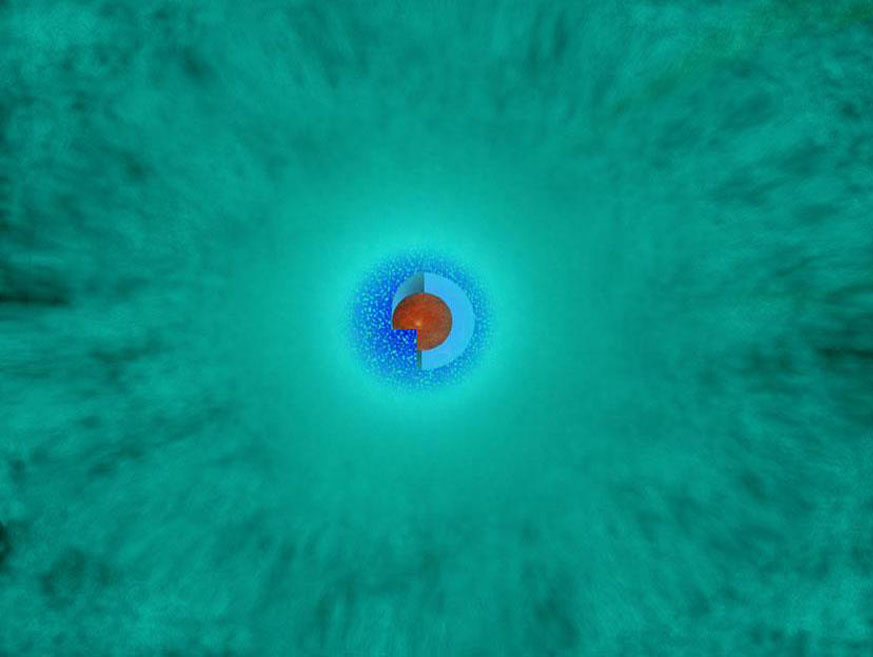
The image above symbolically shows how the nebula, which is mostly made of hydrogen, contracts due to gravity and increases its density to form stars.
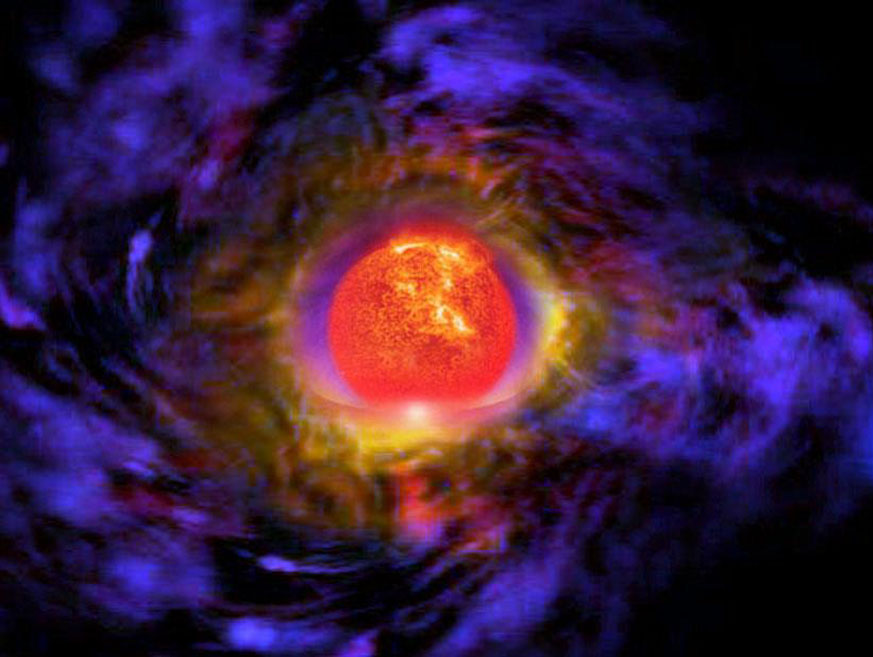
The image above shows the formation of a star. The nebula, which is mostly made of hydrogen, contracts by tens of billions of times to form a star. Therefore, if star-forming galaxy cannot produce hydrogen, it should shrink and shrink by tens of billions of times. However, shrinking galaxies do not exist in the universe.
Galaxies that produce numerous stars simultaneously are not contracting, but rather are expanding at a rapid rate. These galaxies are expanding rapidly, producing explosive amounts of neutral hydrogen. This fact is different from the Big Bang Theory, in which hydrogen should no longer be produced. The fact that hydrogen is still being produced explosively in space is not a new theory or claims. It is an undeniable truth that has been observed and verified by modern space science and technologies.
The mass of the Present Universe has increased and multiplied by thousands of billions of times that of the Early Universe, and it is also expanding at a very fast rate, and this is the fact no one can deny.
According to the Big Bang Theory, the singularity vacuum smaller than the hole of a needle exploded, evolved into the Earth, evolved into the Sun, and evolved into more than 100 billion galaxies in the Universe. And the big bang theorists are teaching such absurd fairy tales, claiming that it is the origin of the universe.
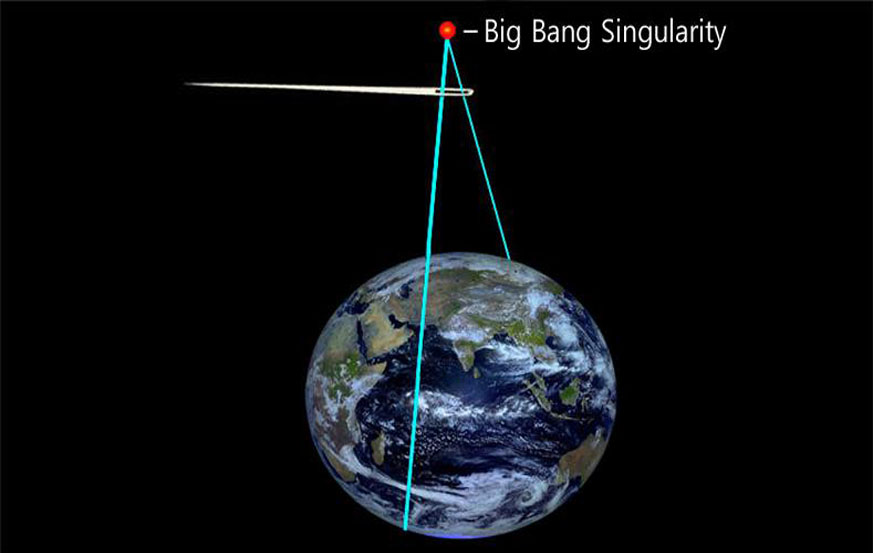
The Big Bang Theory argues That a singularity vacuum much smaller than the hole of a needle, evolved into the Earth. In addition, it is argued that all living things, including humans, on Earth evolved from the Big Bang singularity vacuum, which is smaller than the hole of a needle.

As shown in the image above, the Big Bang theory asserts that not only the Earth but also all stars and planets in the Universe, including the Sun, evolved in a singularity vacuum smaller than the hole of a needle. In terms of the brain capable of normal thinking and the standard of judging things, it can only be an ABSURD CLAIM.
There are about 100 million black holes in our galaxy, and they all have different sizes and masses. Some black holes are more than 20 times the mass of the Sun, and some are more than 4,6 million times the mass of the Sun.
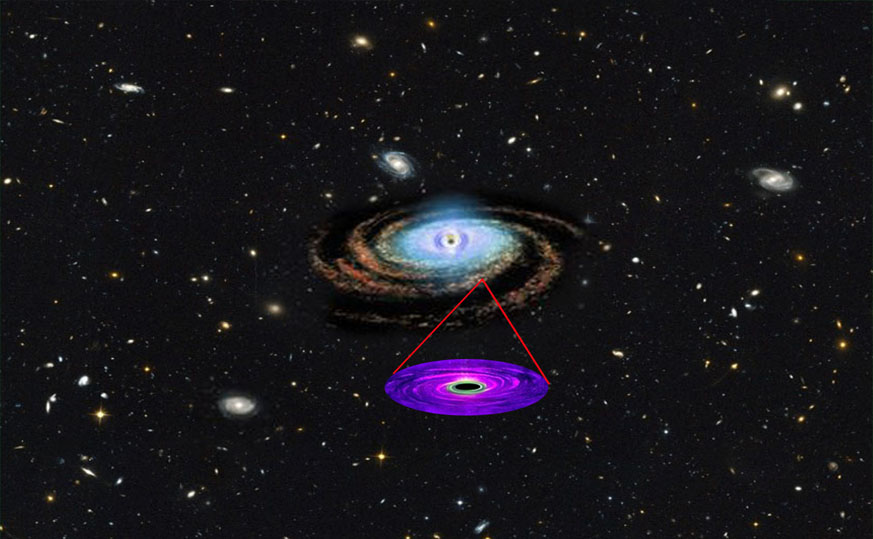
The image above symbolically shows that there are also black holes around the galaxy. And the black holes with the heaviest mass form the core of galaxies. In the core of our Milky Way galaxy, to which the solar system belongs, there is a black hole that is about 4,6 million times the mass of the Sun. And the galaxy called NGC 3842, located 320 million light-years from the Earth, also contains a black hole with a mass of 10 billion solar mass. As such, the masses of black holes are all different, however, the density of black holes is the same at about 18 billion tons per cubic centimeter regardless of the size of the mass.
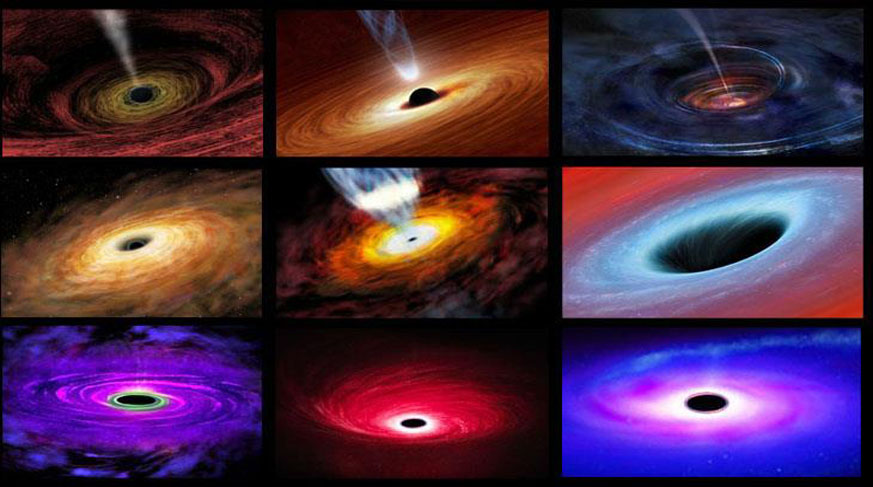
As shown in the image above, black holes have different sizes and masses, but the density of these black holes is about 18 billion tons per cubic centimeter, regardless of size and mass. The fact that the density of black holes is constant regardless of the size and mass of black holes is the truth of the Universe we are seeing now and It Means a Lot.
The density of a black is the final limit to which vacuum can be compressed in space. This is because no object has yet been found in the Universe with a density - mass greater than that of a black hole. The Big Bang theory argues that the Earth, the Sun, and galaxies containing all the stars and planets in the Universe were created in singularity vacuum smaller than the nucleus of an atom. However, if calculated based on the density-pressure of the black hole, the actual mass that can be generated in the singularity vacuum is less than a shovel of soil. If that much mass can be implied in the Bug Bang singularity without exploding, a supernova explosion, which is a catalyst for cosmic evolution, cannot or should not occur.
On February 4, 2015, the theory that reveals the fiction of the Big Bang Theory was published in the Journal of Physical Letter B, of the European Physical Society. “Einstein’s equation shows that the laws of physics break down even before the Big Bang singularity is reached, showing the breakage, but scientists still make irrational inferences that the equations are valid.” says the Professor Robert Brandon Burger, a space scientist at the University of Montreal McGill.
Although they cannot deny the truth revealed in the observed data of NASA and the European Space Agency that the current Universe has increased in mass by hundreds of billions of billion times that of the Early Universe, Big Bang theorists still do not withdraw their claims. However, even now, hydrogen is not depleted in space, but is continuously and explosively generated, expanding the Universe.